What Land Buyers Find Out Too Late
The listing isn't wrong. The city isn't wrong. Nobody asked the next question. Here's what slope, zoning, and utilities can cost when you find them after the offer instead of before.
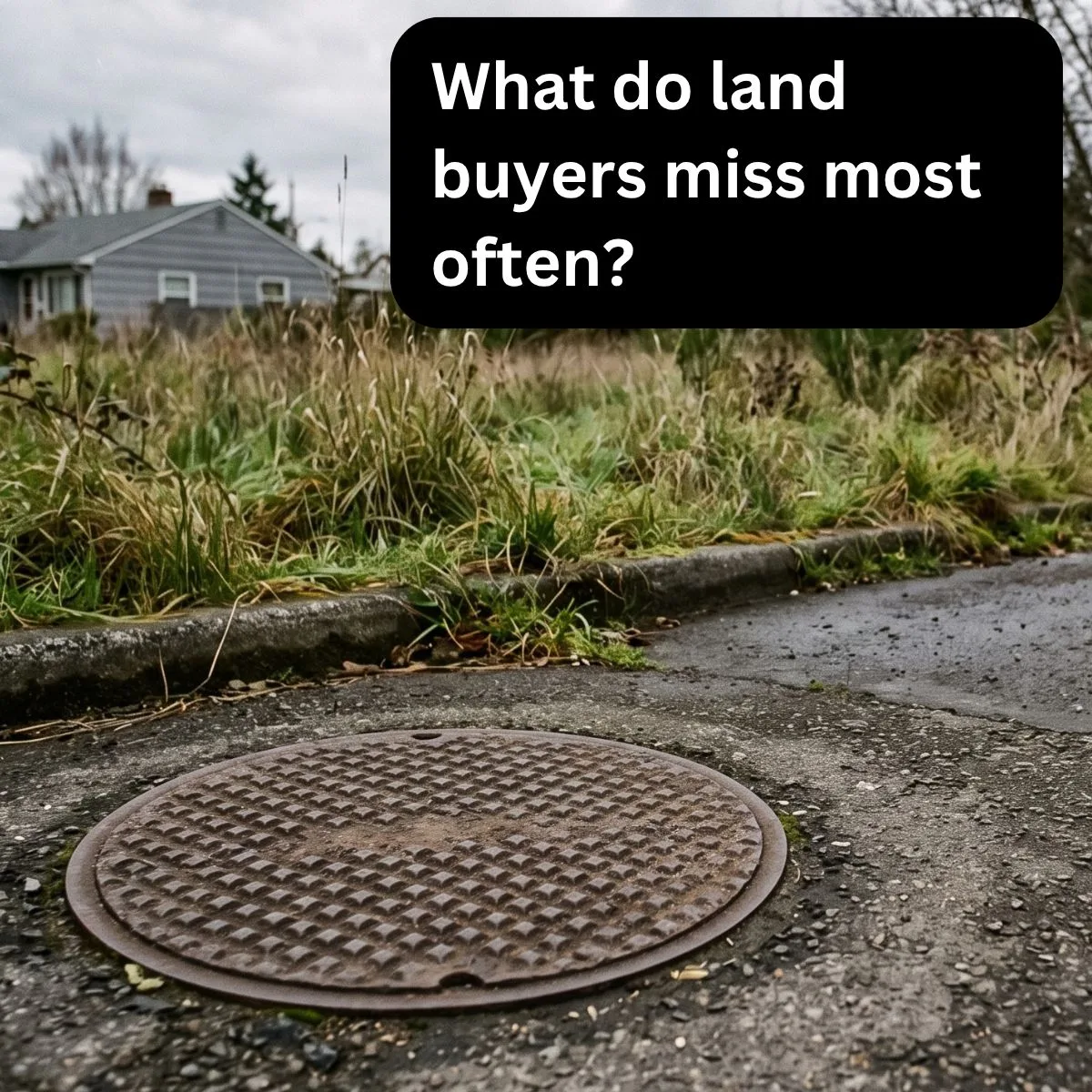
I did an interview with Cotton & Company recently about land due diligence. One question stuck with me afterward: what do buyers find out too late?
I get the same three answers every time: slope, zoning, and utilities.
None of them are hidden. They’re all in public records, on a topo map, or in a code book. The trouble is that each one looks harmless until someone works out what it means for this lot and this house. If you’re buying land to build a house, these are the three places to start asking, “Is my lot buildable, and at what cost?”
1. Slope: the lot looks flat until the topo says otherwise
Six feet of fall across a lot can add $40,000 in excavation and retaining walls before anyone frames a wall.
You won’t see it standing on the property. Grass hides grade, and a lot that feels “basically flat” on foot can still need a daylight foundation, a stepped footing, or a retaining wall along the back line. The topo shows it. Your eye won’t. (For how that plays out once the dirt starts moving, see grading and drainage issues.)
2. Zoning: owning land isn’t the same as being allowed to build on it
I’ve stood on lots with people who already owned them and had to explain there wasn’t a practical path to the house they wanted.
Oregon’s Exclusive Farm Use (EFU) zoning is one I run into regularly. There can be pathways to a dwelling, but they’re narrow and depend entirely on your situation: parcel history, income tests, farm use, and more. A for-sale sign on EFU land doesn’t mean a house is allowed there.
3. Utilities: “nearby” isn’t a measurement
“Utilities nearby” on a listing isn’t a distance. I’ve seen “nearby” turn out to mean 200 feet of mainline extension and an $80,000 bill. (Here’s how that sewer gap adds up.)
Nobody is lying. That’s what surprises people.
If sewer isn’t an option, the perc test decides what kind of septic you can install.
Two deals where a few feet decided everything
Thirty feet outside Spokane. A buyer in a small rural town had an offer in and was still inside the due diligence window. Local rules allowed a septic system only if sewer was more than 300 feet away. Sewer was about 270 feet away. Those 30 feet turned the project from a septic system into a sewer mainline extension.
The annexation chain reaction. Another property sat inside an urban growth boundary. Developing it triggered annexation, and annexation triggered required infrastructure. Sewer was somewhere between 700 and 1,000 feet away. On a 2,000-square-foot home the math didn’t work, and the deal died.
In both cases the city was right and the listing wasn’t wrong. Nobody had asked: what will it take?
The Big 5: what we screen first in land due diligence
Every property we review is screened for five things before anything else, because these are the ones that can kill a project:
| # | Factor | What it can trigger |
|---|---|---|
| 1 | Zoning | Whether a home is allowed at all, plus setbacks, lot coverage, and conditional-use pathways |
| 2 | Floodplain | Elevation requirements, flood insurance, restricted building areas |
| 3 | Wetlands | Buffers, delineation studies, extra permits |
| 4 | Access | Driveway standards, fire apparatus access, easements |
| 5 | Slope | Excavation, retaining walls, geotech reports, stormwater requirements |
Almost every property we review has something: an extra planning review, another permit, a required survey. Most of it isn’t fatal. It’s almost always cheaper to know before the offer than after the loan closes.
Why timing is everything
| Found during due diligence | Found at permit submittal |
|---|---|
| Renegotiate the price | Financing is already locked |
| Redesign the house | Build contract is signed |
| Walk away | The only thing left to adjust is your wallet |
Same issue, same cost to fix. The difference is how many options you still have.
Don’t ask “Can I build on this?”
If you’re buying land, or building for someone who already did, don’t walk into the planning department and ask, “Can I build on this?” That question gets a general answer.
Tell them what you already know, and ask what it triggers:
“I’ve got wetlands in that corner, power over here, and 12% slope across the back. What do I need to watch out for?”
You’ll have a different conversation. Planners are good at telling you what a specific set of facts means. They can’t do much with a question that doesn’t have any facts in it.
Know what it will take before you make the offer
That’s what a SiteFacts Report does. It pulls the Big 5 and the utility picture into one place, with a citation for each finding, so you walk into that planning conversation, or that offer, already knowing the next question.
See a sample report → · Start with a SiteScore →
What’s the question you’ve learned to ask before buying land? We’d like to hear it.
Is your lot buildable?
SiteScore screens any parcel for the Big 5 (zoning, floodplain, wetlands, access, and slope) so you know what it will take before you make the offer.