Land Feasibility Report: When to Order One and Who Pays
Order a land feasibility report inside your contract's investigation window. Who pays depends on the contract. What to tell a buyer client, and when.
A buyer’s agent opens the MLS sheet for a vacant lot, then the title company’s property profile. Both look clean, so the offer goes in and the contract is signed.
The investigation period starts counting down, and nobody documents what the jurisdiction requires of the lot: zoning and setbacks, utilities, legal access, flood zone. The period ends. When the permit office or the lender raises a problem, the buyer may have lost the right to walk away or renegotiate.
Order a land feasibility report inside the investigation period your purchase contract gives the buyer, and early enough to finish before the deadline. Who pays comes down to the contract. SiteFacts recommends the buyer order and pay, the way a buyer pays for a home inspection.
That last part is our recommendation, not a rule of law. The official sources we read set no custom for who pays, and the sections below show what they do say.
When should a land buyer order a feasibility report?
Order it while the contract still gives the buyer a way out. Each form names that window differently. TREC Form 9-18, the Unimproved Property Contract, calls it the Option Period, and the number of days is a blank the parties fill in. North Carolina’s Real Estate Commission describes due diligence as the buyer’s opportunity to investigate the property further, and says the length is negotiable.
This page gives no number of days, because no number holds across contracts. Read the form your buyer is signing.
Ending a contract inside the window has a cost, and so does skipping the paperwork that creates the window. Under paragraph 5B of Form 9-18, a buyer who terminates in time gets any earnest money back, but the option fee will not be refunded. Paragraph 5D covers a different gap: with no option fee stated, or none delivered on time, the buyer does not have the unrestricted right to terminate under that paragraph.
North Carolina’s bulletin covers the deadline itself. The bulletin says termination must be made during the due diligence period and not afterward, and it tells buyers to negotiate enough time to complete their inquiries. That bulletin dates from 2014 and describes the residential form, so confirm how your land contract handles it.
Title review can run on its own clock. Paragraph 6E of Form 9-18 says the commitment should be reviewed by an attorney promptly due to the time limitations on the buyer’s right to object. Put both dates on one calendar.
Timing matters for money too. In our experience, requirements found after financing and construction contracts are in place can turn into change orders instead of a renegotiation. Found inside the investigation period, the same requirement is a conversation about price or a reason to walk.
Screen first, then go deep
Start with a screen, and order the full report on the lots that survive it. A buyer’s agent can have a SiteScore run before the offer is written, then use the contract period for the full Report.
SiteScore checks a lot against zoning (with setbacks), floodplains, wetlands, access and slope, and it comes back in 2 business days. It reads mapped data. A clear screen means the maps showed nothing, not that the lot is clear. A flag is a reason to look closer.
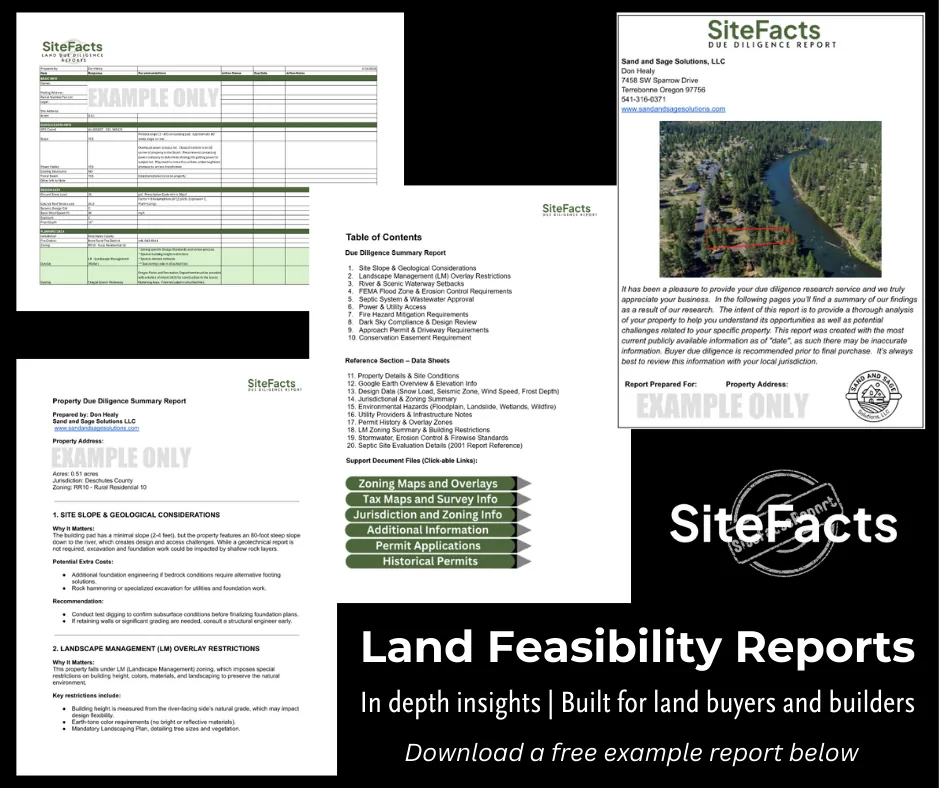
The SiteFacts Report is full due diligence, typically in 7 to 10 business days. It covers zoning, setbacks, overlays, utilities, access, environmental constraints, flood zones, design criteria and active legal and title issues, and it ends with a jurisdiction call list and analyst verification. Count those business days back from the contract deadline, not forward from today.
A feasibility report looks at what the jurisdiction’s records say about the lot, and one California county gives buyers a useful picture of it. Ventura County’s planning division tells buyers to ask whether it is a legal lot, whether the zoning permits the project and whether the lot has legal access to a public road. It also asks about fire department road requirements, septic, flooding and geologic hazards. That is one county’s list, but the questions travel.
The cost of a feasibility study varies by lot and by provider. Ask for a written quote and a delivery date before the clock starts.
For the full what-to-check list, see our guide to building a house on your land.
Who pays for due diligence on land?
The contract decides, and the official forms we read split on it. No source we found sets a national custom.
On TREC Form 9-18, the survey is a checkbox choice. Paragraph 6C lets the parties pick between an existing survey, a new survey at the buyer’s expense or at the seller’s expense, or a new survey the seller furnishes. Paragraph 6A makes the owner’s title policy the same kind of box, at the seller’s or the buyer’s expense. So when someone asks who pays for a land survey, buyer or seller, the answer on Form 9-18 is whichever box the parties checked.
The form’s list of buyer’s expenses in paragraph 12A(2) names lender items such as appraisal fees. We did not find a feasibility study or site investigation listed as either party’s expense. Check with a Texas attorney before telling a client what is customary.
North Carolina’s bulletin says the due diligence fee is negotiated and paid by the buyer to the seller for the right to investigate. It lists inspections, a survey and a title search as things buyers do in that period, but it does not say who pays for them.
Washington points the other way. The state’s statutory disclosure form for unimproved residential property tells the buyer to obtain and pay for qualified experts, including land surveyors, to inspect the property. That is advice printed in a form, not a rule that a seller can never pay.
Our recommendation is simple. The buyer orders the work and pays for it, and SiteFacts’ analogy is a home inspection: a cost the buyer takes on in order to decide whether to close. A buyer who orders it also gets a report that answers to the buyer, with no stake in the sale. If a client wants the seller to share the cost, that is a negotiation, and it belongs in the contract before the period starts.
Is there a home inspection for vacant land?
Not as one document, as far as the sources we read show. For land, the checks are spread across separate specialists and offices.
Ventura County’s list sends buyers to its planning, building, environmental health and fire offices, and to private professionals such as civil engineers, soils firms, geologists and land surveyors. One lot can mean many separate calls. The county’s closing advice is that it is up to the buyer to decide if the lot is worthwhile once the requirements and costs are known.
Form 9-18 points the same way. Paragraph 7D warns the buyer that wetlands, toxic substances or protected species or habitat may affect the intended use of the property, and paragraph 7A tells the buyer to determine the availability of utilities suitable to the buyer’s needs.
Timing advice from extension services is old but still sound. A 1999 University of Wisconsin Extension guide says to include a positive soil test as a condition of sale and test before the closing. Check current state rules before relying on the details.
Is a title report enough?
No. A title report answers a recorded-documents question. It does not answer whether a house can be built on the lot.
The Texas Department of Insurance calls the document a title commitment, so that is the term used here. Other states and companies use other names, so check what yours calls it. TDI’s notice says a commitment is not an opinion or report of your title. It is a contract to issue a policy subject to listed exceptions and exclusions. The notice we read carries a 2014 effective date, so confirm it is current. Form 9-18 says the owner’s title policy is issued subject to the promulgated exclusions, including existing building and zoning ordinances. Indiana’s Department of Insurance lists building and zoning ordinance violations among the exclusions to read for.
Here is what we see on our side. In our reports, a clean title company property profile has not always meant a clean lot. State-mapped wetlands have turned up after national maps showed nothing, and a city overlay followed. A listing’s zoning or flood claim is a starting point that SiteFacts checks against the jurisdiction’s own map, and sometimes it does not hold up. In our experience, the survey or title papers a buyer is handed are not always complete, and older recorded documents have shown easements that the current survey left out. And a mismatch between the listing and the record is a reason to call the jurisdiction, not a verdict, because some flags clear on a phone call.
What to tell a buyer client
Tell them four things, two before the offer and two inside the contract period.
Before the offer, ask who pays and have the lot screened. Settle the cost question first. If the form has a checkbox for the survey, check it on purpose, and say up front if the buyer is paying for the Report. Then run the SiteScore, so a problem shows up in days and not at the permit counter.
Inside the contract period, find the investigation deadline and write it down, along with any separate title review date. Then order the full Report, counted back from that deadline, and take its call list to the jurisdiction. The buyer can then judge fit with their builder or designer, using what the Report documents.
For anything that sounds like a legal question, such as what a clause means or whether a fee is refundable, send the client to a real estate attorney. TREC’s own form says brokers are prohibited from giving legal advice.
What a SiteFacts Report does here, and what it doesn’t
A SiteFacts Report documents the zoning, setbacks, overlays, utilities, access, environmental constraints, flood zones, design criteria and active legal and title issues that apply to the lot. It ends with a jurisdiction call list, and an analyst verifies it. It typically arrives in 7 to 10 business days, so a short window leaves little room to wait. That timing is why the screen comes first.
It does not replace a survey, a title review or an attorney. SiteFacts does not locate pins or confirm dimensions, and the Report does not tell a buyer what the contract allows. It also cannot promise a permit, and it does not decide whether a particular house fits. The buyer makes that call with a builder or designer.
A listing tells you what the seller says about the lot. A title commitment tells you what the policy will insure. A SiteFacts Report documents what the jurisdiction’s rules and maps say about the lot, and it needs to land before the deadline.
Order it inside the investigation period
The Report covers zoning, setbacks, overlays, utilities, access, environmental constraints and flood zones, with a jurisdiction call list. It is not a survey, a title review or legal advice.