How Much House Can an Infill Lot Hold? Start With the Water Meter
Water meter size can cap an infill lot's density. This lot was eligible for middle housing, but the supplier would serve one small home. What to ask first.
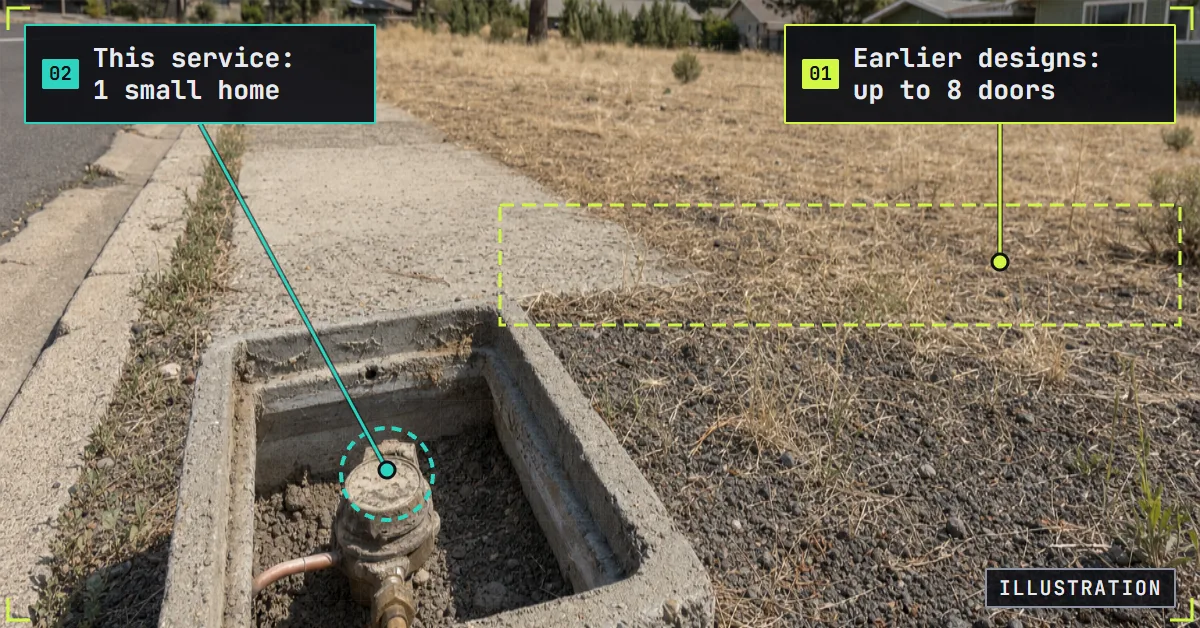
Neighbors say five owners tried to build on the same infill lot in Central Oregon, and we believe water is why none of them did.
The lot is large and in town. It is zoned high density and eligible for middle housing. Development plans were submitted and never finalized, and earlier designs put up to 8 doors on it.
On this lot, the water service capped what could be built, whatever the zoning said.
What gave it away was the water lateral, the service line that runs from the main in the street onto the lot. There was one existing lateral on the lot, and one lateral didn’t appear to fit a plan for up to 8 doors.
What did the water supplier say?
A private supplier under contract with the city is required to serve the lot. Nothing says how much.
The infrastructure in that neighborhood is marginally adequate, and the supplier is very guarded about adding services.
The supplier would serve one dwelling. By the standard fixture count charts, that is a very small house.
The supplier’s flow estimate backed that up. It specified a 5/8 inch by 3/4 inch meter, and a meter that size limits how much water the lot can draw. That is enough for one home with drought tolerant landscaping.
A 3 bed, 2 bath duplex came to about 43.5 water supply fixture units (WSFU), a number that measures how much water a building’s fixtures can demand. That is more than this service covers on the fixture count charts.
What would 8 doors cost in water?
The water improvements for 8 doors mean digging up streets that have since been fully repaved with new asphalt and sidewalks.
That work was quoted at $350K in 2019. My estimate today is $500K to $1M.
If nobody asks the supplier first, a cost like that is missing from your pro forma. To rough in utility and infrastructure costs before you have quotes, the Land Development Cost Calculator gives budget ranges.
Each door adds fixtures to the count. That is how a lot that looks fine on a zoning map can fall short on water.
How do water meters get sized?
Two methods came up on this lot.
The first is the fixture count chart, where you add up the fixtures in the house and the total points to a meter size.
The second is Appendix M of the Oregon Plumbing Specialty Code, which the state adopts under Oregon Administrative Rule 918-750-0110. It is a peak demand method. It assumes water efficient fixtures and the chance that fixtures run at the same time. It can allow more than the fixture count charts, if the water supplier accepts it.
The supplier agreed to issue a will serve letter, its written commitment to supply water, for a 4 bed, 3.5 bath home. Appendix M is what got us there.
That is a bigger house than the charts allowed, and it is still not 8 doors.
What should you ask before you commit?
Ask in writing, before you build the pro forma on density and before you close. You can copy these into an email.
To the water supplier:
“How much water will you serve at this address? I am asking about capacity, not only whether you will serve the lot.”
“What size service and meter will you provide?”
“Do you size meters by fixture count charts, or will you accept Appendix M peak demand sizing for the project I am planning?”
“If I want more than one dwelling, what main or service work would you require, and who pays for it?”
“Will you issue a will serve in writing, and for what size home?”
To the city (under Oregon Revised Statutes 92.031(4)(g), a city may require separate water and wastewater service for each dwelling unit in a middle housing land division):
“Do you require separate water and wastewater service for each unit on a middle housing land division?”
What carries over to your next deal
This is one lot with one supplier arrangement, and yours may have different paperwork. The questions carry over. We have seen the same gap with sewer, where a city sewer line nearby meant $100,000 or more in development cost.
Zoning told this lot what it could hold on paper. The water supplier would serve one dwelling.
A SiteScore is a quicker first screen for zoning, floodplain, wetlands, slope, and access. It does not cover water.
Check utilities before you underwrite the density
The SiteFacts Report checks water availability, from the main at the street to the lateral on the lot.
Related reading
 Due Diligence
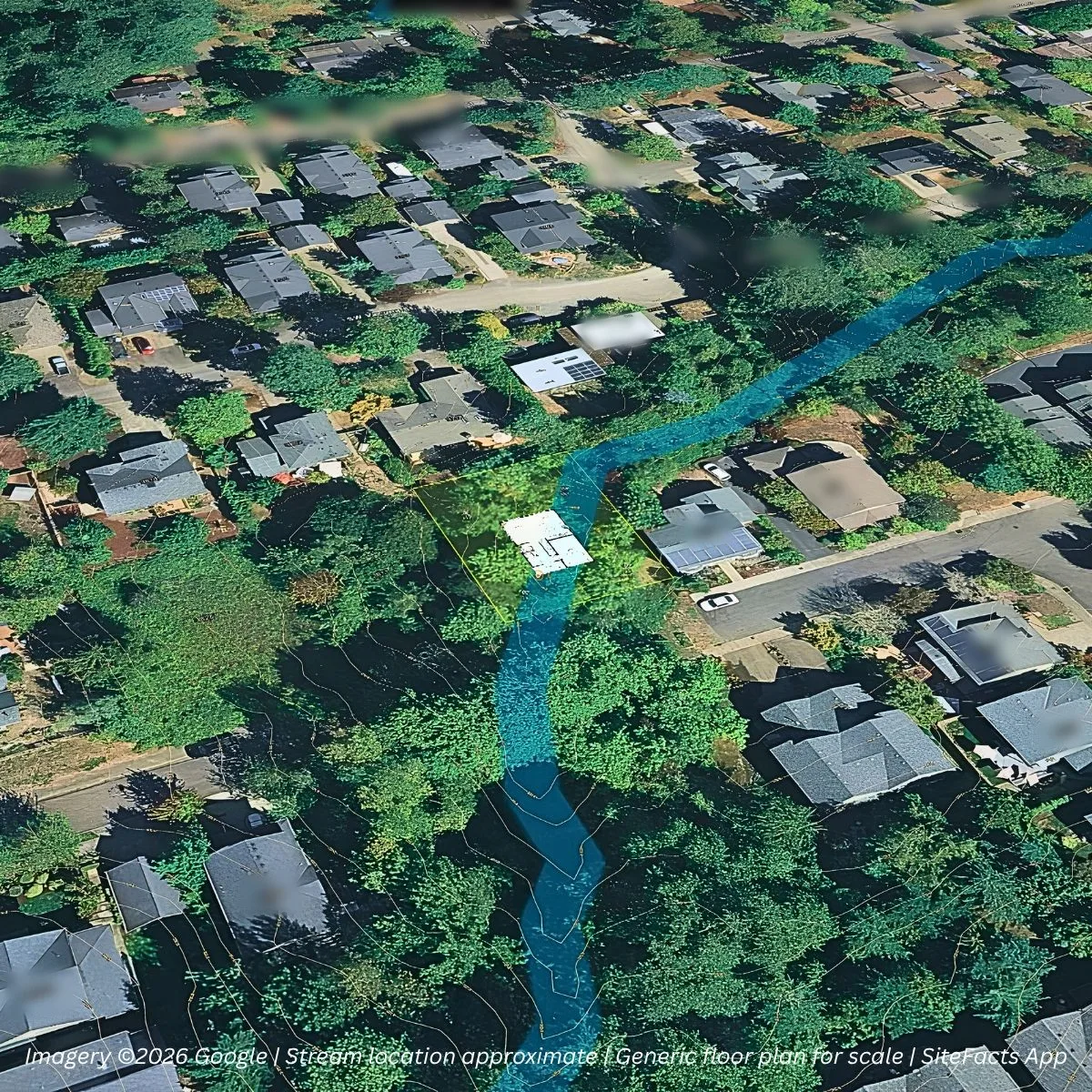
Why Is That Infill Lot Still Vacant?
Every reason to buy was on paper. Every reason to walk was under the trees. A Pacific Northwest infill case study, and the seven checks to run before you buy a vacant lot in the city.
Read Permits
Sidewalk Requirements for Infill Lots: Avoiding Costly Surprises
Sidewalks are a building-permit condition, not a property disclosure, so they never show up in the paperwork. On a corner infill lot, that's a $9,600 change order after your loan has already closed.
Read Utilities
Power Planning Guide: Electrical Service for Your New Home Build
Most first-time builders think power is a phone call to the utility. It's actually one of the longest-lead items in the whole build, and the number one cause of construction delays.
Read