Flood Insurance on New Construction: Why Meeting Code Doesn't Set Your Premium
An elevation certificate is optional for NFIP flood insurance now, but it can affect the rate. Why meeting code and your premium are separate.
Last reviewed: 2026-11-05. Flood rules change and vary by jurisdiction. Confirm with your local floodplain administrator and an insurance agent.
A customer brings you a lot in a flood zone and asks what flood insurance will cost if you build the house to code. Many customers expect the answer to be normal.
Your jurisdiction decides whether you can build and how high. Your insurer decides what flood coverage costs.
Under Federal Emergency Management Agency (FEMA) Risk Rating 2.0 pricing, each building is rated on traits like first floor height above the ground. An elevation certificate is optional for federal flood insurance, but it can affect the rate.
An elevation certificate, or EC, is the FEMA form that records how high a building sits compared with the base flood elevation, or BFE. The BFE is the height floodwater reaches in a flood with a 1 percent chance of happening in any year. A licensed surveyor signs the EC, or an engineer or architect where state law allows.
This page shows why the two answers differ and what to tell your customer before you quote. It expands the insurance section of Part 1.
Table of contents
- Who decides what: the jurisdiction or the insurer?
- How does Risk Rating 2.0 price a new home?
- Why can a house that meets code still get a high premium?
- Do I need a flood insurance elevation certificate?
- Does building higher than code lower the premium?
- Will my customer’s lender require flood insurance?
- NFIP or private flood insurance: who sets the rules?
- What should I do before I quote a flood zone build?
- What a SiteFacts Report does here
- Terms on this page
Who decides what: the jurisdiction or the insurer?
The jurisdiction decides whether you get the permit and how the house has to be built. The insurer decides what coverage costs. They use different rulebooks and look at different numbers.
| The jurisdiction | The insurer | |
|---|---|---|
| Who decides | The floodplain administrator, under the local ordinance | FEMA for a National Flood Insurance Program (NFIP) policy, or a private insurer for a private policy |
| What they decide | Whether you get the permit, and how the house must be built | What coverage costs |
| What they measure | The lowest floor against the BFE, plus any local freeboard | First floor height above the adjacent grade, along with other building traits |
| Document used | The permit file and the elevation certificate | The building’s rating, and an elevation certificate if the owner submits one |
| What the flood map does | Drives the local building rules | Informs the models behind the NFIP rate |
Freeboard is extra height above the BFE that a community requires as a safety margin. The NFIP is the federal program that sets floodplain rules for communities and offers flood insurance.
FEMA’s Risk Rating 2.0 FAQ says flood map data informs local floodplain management building requirements and mandatory purchase requirements, and also informs the models used to develop rates. The map feeds both sides. It does not make them the same question.
On the permit side, SiteFacts has seen a Texas lot in Zone AE where the existing grade already sat at the BFE, so the lowest floor only had to rise by the local freeboard.
How does Risk Rating 2.0 price a new home?
It rates the building itself, not just the flood zone on the map. FEMA’s Risk Rating 2.0 fact sheet says the rating is specific to the building, and that new policies effective on or after October 1, 2021, are priced under it.
The same FAQ lists the variables as flood types, distance from a flooding source, frequency of flood, elevation and the cost to rebuild a property. FEMA’s April 2022 discount guide adds foundation type, flood openings, machinery and equipment, and number of floors.
So there is no single Zone AE price. Zone AE is a high-risk zone where the BFE is printed on the map, and FEMA rates the building, not just the zone.
Some of those variables are your decisions: the foundation, the openings, the first floor height and where the equipment sits. Others, like flood frequency and distance from the water, belong to the lot.
Why can a house that meets code still get a high premium?
Because the permit and the premium measure different things. Compliance gets the permit. It does not set the price.
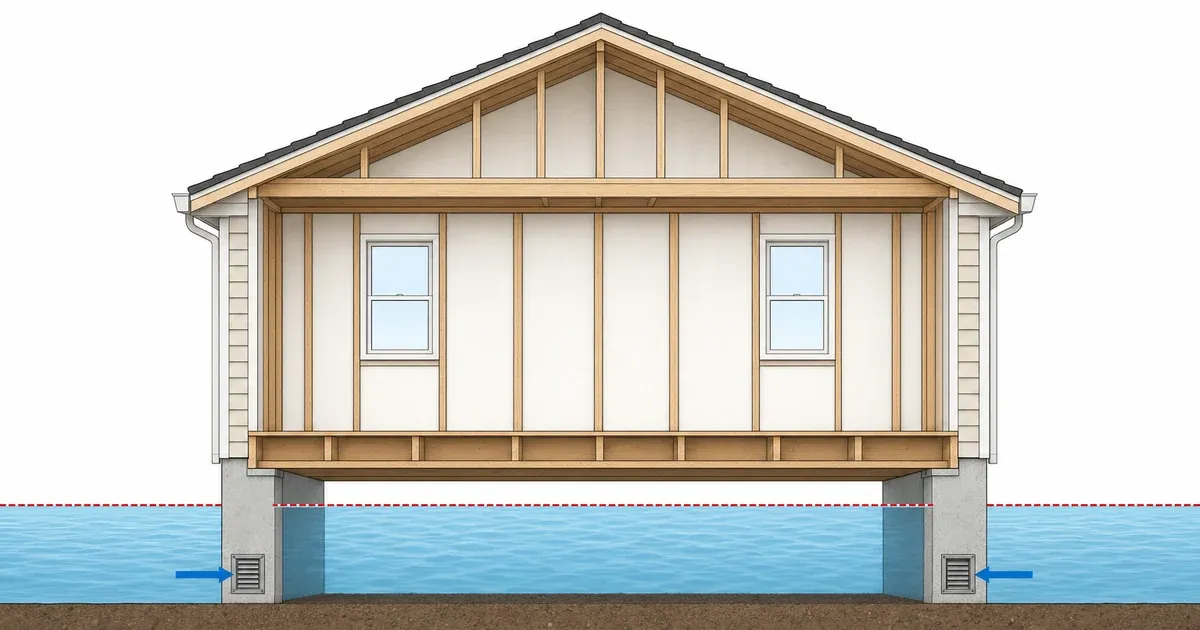
The jurisdiction measures the lowest floor against the BFE, plus any local freeboard. FEMA’s rating uses first floor height, which its discount guide defines as the height of the building’s first lowest floor above the adjacent grade.
In SiteFacts’ reading, these are two measurements of the same floor, from two starting points. One starts at the flood elevation. The other starts at the ground.
For example, say the BFE is 100 feet, the ground at the house sits at 99 feet, and the jurisdiction requires 2 feet of freeboard. The lowest floor has to reach 102 feet, which puts it 3 feet above the ground.
Now say the ground sits at 100 feet. The floor still has to reach 102 feet to meet the permit, but it is only 2 feet above the ground.
The permit asks whether the floor is at 102. The rating asks how far the floor is above the ground. Those are different questions.
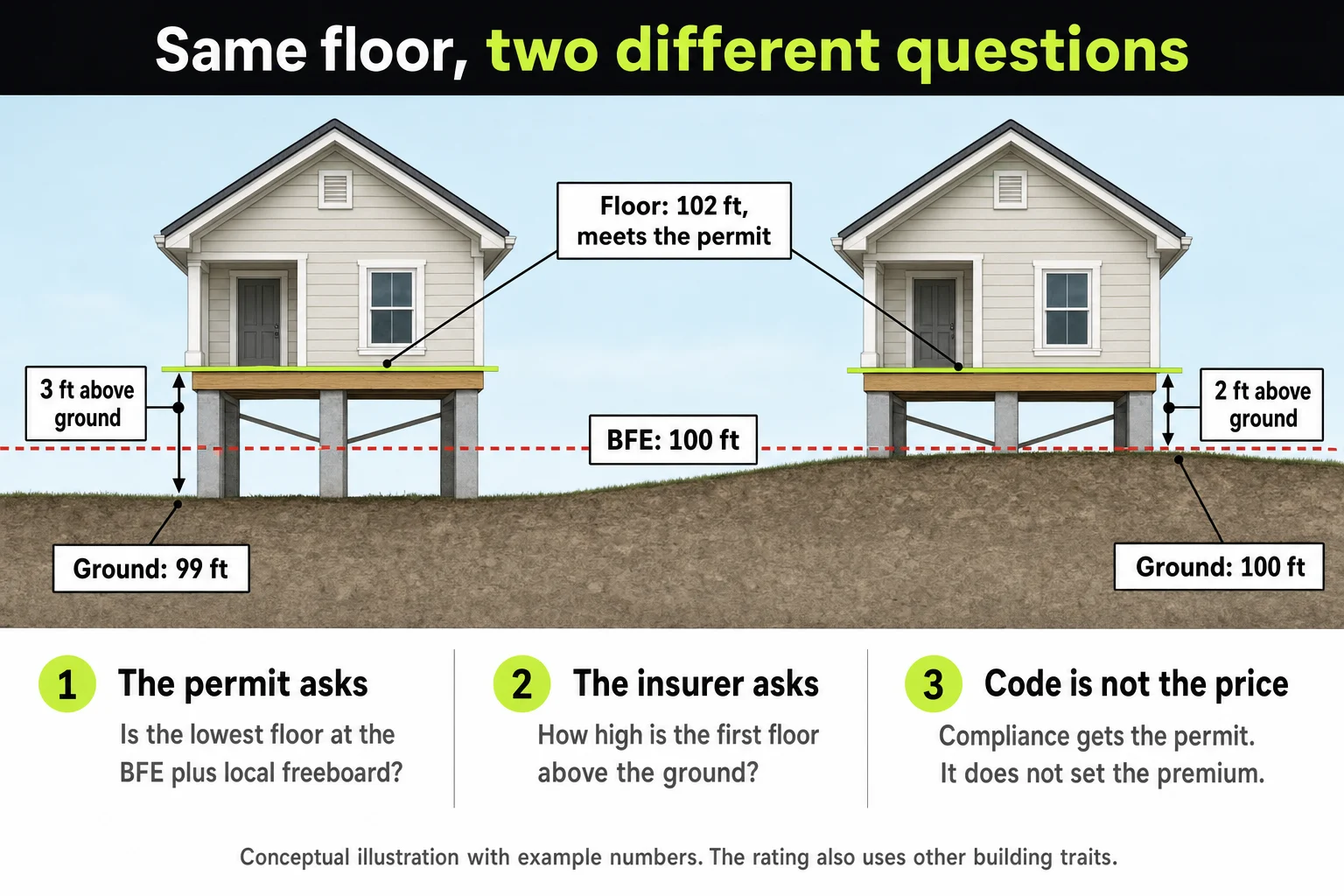
In our experience, you can do everything a jurisdiction requires and still pay a top level flood insurance premium.
Compliance still matters. FEMA’s FAQ says buildings that are not in compliance with community floodplain management regulations are ineligible for the CRS premium discount. The CRS, or Community Rating System, is the FEMA program that gives discounts in participating communities.
If you tell a customer insurance will be normal and the quote comes back high, you are the one who has to explain it.
Plain words for your customer: “Building to code gets you the permit. It doesn’t set your insurance price. We’ll tell you what the jurisdiction requires. The insurer tells you what it costs. Get a quote from an insurance agent before you commit, and bring the elevation certificate once the surveyor has done one.”
Do I need a flood insurance elevation certificate?
No, not to buy NFIP flood insurance. FEMA’s Risk Rating 2.0 FAQ says an EC is no longer required to purchase coverage, and that FEMA uses its own tools and resources to determine elevation data for a building.
An owner can still submit one to the NFIP insurer to see whether it will affect the rate. The same FAQ says ECs continue to be used for floodplain management building requirements.
So one form does two jobs. The jurisdiction can require it as the compliance record. The insurer treats it as optional rating evidence.
Local rules vary. In Lane County, Oregon, the code has the administrator obtain an EC once the lowest floor is placed and before further vertical construction, and an as-built EC before the final inspection, under Lane Code 16.244. Ada County, Idaho, says it will not issue a certificate of occupancy until the final elevation certificate is submitted.
A completed EC does not expire unless the building physically changes in a way that invalidates the information on the form, and a change of owner does not void it, according to FEMA’s EC instructions. SiteFacts’ advice is to keep the final certificate on file so you can hand it to the customer’s insurance agent. Part 2 covers timing and cost.
Does building higher than code lower the premium?
Generally, yes, in direction. FEMA’s April 2022 discount guide shows the rate dropping as first floor height rises. How much it drops for a given house comes from an insurer’s quote.
FEMA’s FAQ says mitigation efforts such as elevating a building, installing proper flood openings in a crawlspace or enclosure, and elevating certain machinery and equipment will help reduce flood damage and potentially the cost of flood insurance.
FEMA’s rating documents give the variables and the direction, not a conversion from a freeboard number to a premium. Do not promise your customer a saving. Send them to an insurance agent for the number. Part 3 covers how many vents.
Will my customer’s lender require flood insurance?
Often, for the house. FEMA says Congress mandates that federally regulated or insured lenders require flood insurance for buildings in the Special Flood Hazard Area, or SFHA, when the loan is federally backed. The SFHA is the land FEMA maps as having a 1 percent chance of flooding in any year.
Lenders can ask for more. FEMA’s FAQ says lenders retain the right to require flood insurance beyond what federal law requires.
The federal rule attaches to a building, not to bare ground. In the Code of Federal Regulations, or CFR, the Federal Deposit Insurance Corporation (FDIC) rule at 12 CFR 339.3(a) says coverage is limited to the building and any personal property that secures a loan, “and not the land itself.”
How a lender treats a lot loan or a construction loan in a flood zone is the lender’s to explain, so ask before the customer closes.
NFIP or private flood insurance: who sets the rules?
FEMA rates NFIP policies. An insurer underwrites a private flood policy, and a state insurance department regulates it, not the floodplain administrator.
Florida shows how one state does it. Florida’s insurance regulator says state law requires most flood insurance policy types to be at least as broad as the NFIP, and that section 627.715, Florida Statutes, sets guidelines for private flood filings. Other states set their own rules.
On the lender side, the FDIC rule says a lender it supervises must accept a private policy that meets the definition in 12 CFR 339.2 and the coverage requirements in 339.3(a), under 12 CFR 339.3(c).
Ask each insurer what it needs, such as an elevation certificate or a minimum floor height.
What should I do before I quote a flood zone build?
SiteFacts’ advice, not a rule: get the insurance question answered before you lock the floor height and foundation.
Ask the customer to call an insurance agent early, with the lot’s address and the floor plan, and get a quote. That quote is the number. Your price for the foundation is a different number.
Give the agent the elevation data from the surveyor, and the elevation certificate when you have it. Then tell the customer plainly which questions belong to the jurisdiction, which to the lender and which to the insurer. Part 1 covers the permit side.
Do not promise a premium in the sales conversation or the contract. You control the build. You do not control the rate.
What a SiteFacts Report does here, and what it doesn’t
A SiteFacts Report flags the mapped flood zone and the overlays that apply to a lot, and it gives you a jurisdiction call list. Each report is analyst verified and typically delivered in 7 to 10 business days.
It does not price flood insurance, predict a premium, survey a lot, prepare an elevation certificate or make a flood determination. An insurance agent quotes the premium, a surveyor prepares the certificate, and the floodplain administrator decides what the lot needs.
Know what applies to the lot before you quote
Order a SiteFacts Report on the lot before you quote. It flags the mapped flood zone. The premium comes from an insurance agent.
Terms on this page
- BFE (base flood elevation): the height floodwater reaches in a flood with a 1 percent chance of happening in any year.
- CRS (Community Rating System): the FEMA program that gives premium discounts in participating communities.
- EC (elevation certificate): FEMA’s form that records how high a building sits compared with the BFE.
- FDIC (Federal Deposit Insurance Corporation): the federal bank regulator whose lender rule is cited here.
- FEMA (Federal Emergency Management Agency): the federal agency that sets national flood rules and runs the NFIP.
- First floor height: the height of a building’s first lowest floor above the adjacent grade.
- Freeboard: extra height above the BFE used as a safety margin.
- NFIP (National Flood Insurance Program): the federal program that sets floodplain rules and offers flood insurance.
- Risk Rating 2.0: FEMA’s method for pricing NFIP policies, specific to each building.
- SFHA (Special Flood Hazard Area): the land FEMA maps as having a 1 percent chance of flooding in any year.